
At the 2027 National Championships in Perth, and subsequent national championship events, Masters Swimming Australia (MSA) will be adopting new measures to better recognise the swimming abilities for MSA member swimmers registered with a Multi-Class (MC) classification.
MSA has a modest but dedicated membership of MC swimmers. At present, these swimmers are eligible to participate in National Championships events but their individual performance has been inadequately recognised. Competing against able-bodied (AB) swimmers means a MC-classified swimmer is less likely to medal, even though their individual performance when compared to others would warrant the award of a medal, and the awarding of points and eligibility for awards.
From 2027 this will change. Under the new arrangements, MC-classified swimmers will have their individual performances benchmarked against AB swimmers’ performances (using World Aquatics points). Where the individual MC swim would result in the awarding of a first, second or third place in that event and age category, an additional medal and points will be awarded to the MC swimmer. MC swimmers will also be able to set records for their swims. Please see the below FAQ’s for details on how this works.
This arrangement will ensure better recognition for MC swimmers and is intended to further uplift the spirit of fair competition and camaraderie which exists at National Championship events.
FAQs
How is Multi Class competition integrated with Masters swimming?
The integration of MC competition with able-bodied Masters competition requires a change to how the overall competition results are calculated.
Whereas the existing Masters results system takes into account a swimmers age, it makes no allowance for a disability, and the existing MC results system takes into account a swimmer’s disability, but makes no allowance for a swimmer’s age.
The method used seeks to integrate the requirements of both systems, evaluating each swim and allocating points through a comparison of their swim time against the relevant World record using a modified World Aquatics points formula:
This means MC swimmers compete in the same events as able-bodied swimmers, with a points-based system for results adjusted to account for both disability and age.
The system to be utilised has been used at MSNSW meets since 2019.
What is the difference between the old and new results systems?
- The traditional Masters system accounts for a swimmer’s age, but not disability.
- The Multi Class system accounts for a swimmer’s disability, but not age.
- The new integrated system combines both, using a points formula for fair comparison across all swimmers.
How are results calculated?
Results are calculated using a World Aquatics points formula, which compares a swimmer’s time to the relevant world record for their classification, distance, stroke, and course, but is modified to include a conversion factor to adjust for age; ensuring that both age and disability are fairly represented.
The points are calculated using the above cubic curve, where:
- T is the swim time in seconds
- B is the base time in seconds
- F is a conversion factor, for MC competitors only, to account for the swimmer’s age.
The base time is the reference or “record” time used for comparison in the points formula:
- For able-bodied swimmers, the base time is the relevant world record for stroke + distance + course+ age group, published on the MSA results portal at the date for close of entries for the meet.
- For swimmers who choose to nominate an approved MultiClass classification for the meet, the base time is the relevant time for stroke + distance + course + classification, published on the Swimming Australia website at the date for close of entries for the meet. For able-bodied swimmers, it’s the World Aquatics Record for their stroke, distance, course, and age group.
The conversion factor (F) adjusts MC swimmers’ results to reflect their age, since official MC base times do not account for age.
It is calculated from the degradation of Masters world record times (current at closing date for entries) over the age groups, and will vary by gender, course, stroke, and distance.
The following chart provides average data, for guidance only: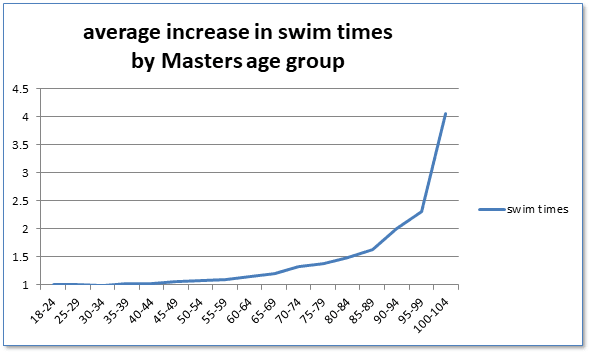
Yes,
- As there are no masters world records for the 18-24 age group, able-bodied base times for 18–24 are taken as equal to the 25–29 age group.
- As there are no MC base times for the 800m Freestyle, novel base times are are calculated using the average percentage increase between 200m and 400m MC base times.
- As there are no world records for either able-bodied or Multiclass for 25m events, novel base times are calculated using the average percentage decrease between 100m and 50m base times.
- As there are no world records for either able-bodied or Multiclass for 25m events, novel base times are calculated using the average percentage decrease between 100m and 50m base times.
This is a placeholder tab content. It is important to have the necessary information in the block, but at this stage, it is just a placeholder to help you visualise how the content is displayed. Feel free to edit this with your actual content.
Able-bodied swimmers: MSA Results Portal (at the close of entries for the meet).
Multi Class swimmers: Swimming Australia website (at the close of entries for the meet).
Will this change affect able-bodied swimmers?
No, placings among able-bodied swimmers within each age group will remain unchanged..
Under a “no disadvantage” regimen, where MC swimmers move up in placings, able bodied swimmers will not be displaced from event placings, medals, nor individual & club meet points – equal medals, placings and meet points will be awarded.
The new points system mainly ensures fairer opportunities for MC swimmers.
How does this benefit Multi Class swimmers?
MC swimmers can now compete meaningfully within the same events as all other Masters swimmers.
Exceptional performances (relative to world records in their classification) will be recognised in individual meet results and club point scores.
Note that in the event that the MC points calculation results in lower points than the World Aquatics points for any particular swim, under a “no disadvantage” regimen, the higher points will be awarded.
Where can I find the official base times and records?
- Able-bodied swimmers: under the Records tab on the MSA Results Portal (at the close of entries for the meet).
- Multi Class swimmers: search for “MCPS” on the Resources page of the Swimming Australia website (at the close of entries for the meet).
What is a MC classification and why is it important?
Classification determines how a swimmer’s disability impacts their ability to perform swimming strokes.
Each swimmer is assigned a classification (e.g. S9, SB8, SM9) that allows for fair comparison between swimmers with different disabilities.
You’ll find full details and application steps on the Swimming Australia website: https://www.swimming.org.au/performance/elite/classification
To obtain a new or provisional classification, contact Swimming Australia by phone, email or via this form:
Multiclass classifications group swimmers based on how their specific impairment impacts their functional ability to swim, rather than the impairment itself.
Classifications use a prefix letter (or letters) denoting the stroke, followed by a number that indicates the level of impairment.
Event Prefixes:
The prefix letters indicate which strokes an athlete is swimming:
- S: Freestyle, backstroke, and butterfly.
- SB: Breaststroke.
- SM: Individual medley.
Categories:
Physical Impairments (Classes 1–10)
Swimmers in these classes are assigned a number from 1 to 10, where a lower number indicates a greater degree of impairment. These classes encompass various conditions, including muscle weakness, limb loss, or coordination issues.
- S1–S2: Severe physical impairments; for example, significant movement difficulties across all four limbs.
- S3–S4: Significant physical impairment; restricted use of limbs or missing limbs.
- S5–S6: Moderate physical impairment; includes athletes with short stature, loss of function in lower limbs, or moderate coordination problems.
- S7–S10: Progressively less severe impairments. Class S10 represents the minimum eligible impairment (e.g., restricted movement in one hip or minor physical anomalies).
Visual Impairments (Classes 11–13)
- S11: Very low visual acuity or no light perception. Athletes are required to wear blacked-out goggles and often use an assistant (tapper) to signal the pool wall.
- S12: Higher visual acuity and/or a smaller visual field than S11.
- S13: Least severe vision impairment eligible for Para sport.
Intellectual Impairment (Class 14)
- S14: Swimmers with intellectual disabilities who demonstrate an IQ score of 75 or below, along with significant limitations in adaptive behavior.]
- S18: Swimmers with Down Syndrome, or class-S14 intellectual impairment combined with a physical impairment
- S19: Swimmers with autism
Hearing Impairment (Class 15)
- S15: Swimmers with hearing loss
S16: For solid organ or bone marrow transplant recipients
S17: A provisional or transition classification specifically designated for athletes with motor learning difficulties, most commonly dyspraxia (Developmental Coordination Disorder)
Exceptions:
Multiclass swimming exceptions are specific, classified modifications to standard swimming rules that allow athletes with physical, visual, or intellectual impairments to compete fairly without being disqualified. These adaptations are designated by a standardized system of codes determined during the swimmer’s official classification proces
STARTS
A = Assistance Required
B = Blackened Goggles
E = Unable to grip for backstroke start
H = Hearing impaired light or signal required
T = Tappers
Y = Starting device
DURING SWIMMING
0 = Nil
1 = One hand start
2 = Right hand touch
3 = Left hand touch
4 = Right hand touch with simultaneous intent to touch with other
5 = Left hand touch with simultaneous intent to touch with other
6 = Simultaneous intent to touch
7 = Part of upper body must touch
8 = Right foot must turn out
9 = Left foot must turn out
12 = Leg drag or show intent to kick
STROKES
FREESTYLE – no exceptions (nil)
BACKSTROKE – only exception 1 may apply
BUTTERFLY – only exceptions 2 to 7 may apply
BREASTSTROKE – only exceptions 2 to 12 may apply
How can I get classified?
To obtain a new or provisional classification, contact Swimming Australia by phone, email or via this form.
You’ll find full details and application steps on the Swimming Australia website: https://www.swimming.org.au/performance/elite/classification
Where can I find the MSA policy document on the inclusion of Multiclass competition at the National Championships?